Mirrors of Semitism
High hopes for the Nakba Museum fade as Saul realizes that Palestinians are mirroring the flaws of the Jewish state. Victimhood is a powerful tool for forging a cohesive national identity.

This is a snippet from a book I’m writing. This is the premise:
The year is 2040, and the Middle East has entered an unprecedented period of prosperity and peace. A two-state solution has been achieved in Israel, tensions between Saudi Arabia and Iran have eased, and even discussions about creating a Kurdish state are underway. Millennia-old conflicts have been set aside in favor of commerce and addressing climate change.
Thirty-year-old layabout Saul Stern is apathetic, apolitical, and a self-described “hedonist incapable of experiencing pleasure.” In the summer of 2040, Saul receives a proposition from his father: participate in a 10-day Birthright program, and afterward, he’ll secure a cushy job in the tourism division of a Zionist lobbying agency rebranded as the Cradle of Civilization Unity Coalition (CCUC), an organization that promotes American investment in this new era of Middle Eastern peace.
Yet there are dark undercurrents beneath this veneer of tranquility. The smell of blood is in the air.
But none of this matters to Saul, who is guided chiefly by his libido. He finds himself entangled in a love triangle with two women on opposite sides of the ideological spectrum—Hadassa, an IDF soldier, and Tara, who claims she’s on Birthright solely to write a think-piece on indoctrination.
Saul's lust blinds him to the fact that both women are preparing for horrific acts of violence. Hadassa plans to assassinate a leftist politician, while Tara intends to detonate the vest, forever staining Birthright in the American mind.
But who can blame him? The water is warm. The passionfruit juice is refreshing. The women are beautiful. The American dollar is strong. Why worry?
Salma wears her hijab like a cosmopolitan Turk—burgundy, slipping just enough to reveal a band of hair that stirs Arab boys and reassures Western tourists that this is not fully a land of female subjugation. In a neutral accent, tinged with British vocabulary common among the Jordan-educated, Salma explains that Mathaf Al-Nakba, The Nakba Museum, was chosen to be here for a "host"—not the American kind, nor a bunch—of reasons.
Lifta—a better-preserved abandoned village—would have been ideal but was infeasible due to its location in Israel proper. Deir Yassin, though less preserved, carried the most emotional weight—or "pain capital," as Jukka would call it—but was similarly out of reach. Al-Walaja, near Bethlehem, was a feasible option and enticing for its proximity to the birthplace of Jesus, which promised spillover from Western Christians. However, its partial repopulation made forced eviction heavily considered but, in the end, out of the question.
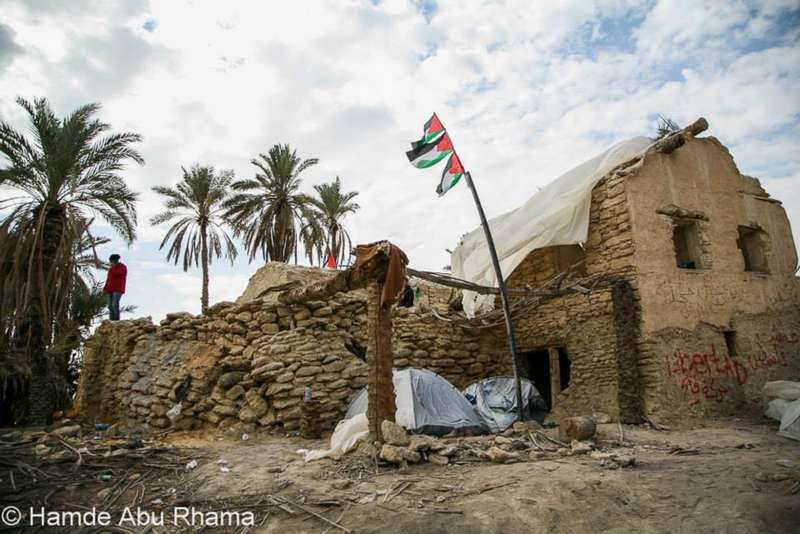
And so, by process of elimination, Ein Hijleh was chosen. A decent choice, its abandoned village of gleaming limestone provides the perfect contrast to the ideal Palestinian land—the Palestine of memory. Rugged but not ugly: you must work it, but it will reward you. Flatlands dotted with date palms and humble fields are framed by the distant hills of the Jordan Valley. The Jordan River lingers between a rush and a trickle. You can slap on any sentence about resilience over this landscape. Perhaps: “Centuries of exile, could not stop the water from flowing, could not stop the dates from sprouting.” To drive it home, I’d suggest adding something biblical—Abraham has the safest, most nondenominational appeal.
Later in the day, I would receive an email from a Tunisian-Palestinian feminist organizer employed as a consultant on “domestic (as in of the house, not the nation) affairs.” Attached was her rough manuscript, The Nakba Industry, which offered this observation about the beautifully preserved vista:
“While hydroelectric facilities, housing, and large-scale agriculture are undoubtedly needed in the Jordan River Valley, nothing is allowed to taint the view: the stark abandonment of the village juxtaposed against the serene, longed-for, and now partially realized land. Yet this preservation comes not only at the expense of practical needs but also of truth. Several structures have been reconstructed to reflect the village’s original form—though no blueprints exist. One must imagine these reconstructions are based on the embellished tales of refugees, stories that grew more painful and grandiose as they were passed down through generations. Perhaps most distasteful is the erection of a mosque in 2037, only for it to be partially destroyed and left deliberately withered, much like a wealthy patron might commission an intentionally distressed chair, or a teenager might don factory-ripped jeans. Such calculated decay tugs at the heartstrings of Arab and Western tourists alike, and increasingly, those from China and Brazil.
Truth is not sacrificed solely for the preservation of a narrative—it is also withheld for political reasons. Notice how there is never any mention of the blunders, hubris, and self-interest of the Arab armies—Egypt, Jordan, Syria, Iraq, and Lebanon—that contributed to the Nakba. There is no nuance addressing the mutual disdain Palestinians held for these armies, who often acted as occupiers rather than liberators. Nowhere is there an asterisk to the narrative of immoral, unwarranted expulsion by Jews. The Nakba is presented solely as an act of impractical cruelty, not as a partially inevitable military outcome. This simplification serves not just to keep tourism dollars flowing and manufacturing ties with Jordan and the Gulf states secure, but most importantly, to protect the national raison d’être from even the slightest dent.
But my frustration with the newly opened “Nakba Museum” doesn’t stem from historical inaccuracies—it stems from hypocrisy. Shouldn’t they have learned from their Zionist oppressors that a nation built on victimhood only paves the way for unchecked cruelty—for pain to be not just remembered, but celebrated, then passed down to those weaker? The R.O.P. should be breaking away from the Arab tradition of lecturing without inviting questions, fostering critical thinkers instead. We must cultivate a future Palestinian generation that looks forward, unburdened by the label of refugee. Instead, the Nakba Museum stands as a foreboding sign of what’s to come. Perhaps they’ve conceded that Israel was right: clinging to suffering is an effective way to forge national unity among a fractured refugee diaspora.”
Despite Tiziri Aït Salah’s ideological qualms, the ruins are effective—at least to me. Light streams through the holes in the walls of what was once a kitchen, illuminating pottery fragments, rusted tools, and the occasional fallen roof beam scattered across the floor. Only one item remains untouched: a red clay bowl painted with the tale of Juha’s Olive Tree. Juha plants an olive tree and is asked why he bothers, knowing it will take years to bear fruit. Juha replies, “Others planted so we could eat; I plant so others can eat.”
The plaque tells me this—I had just assumed they chose to depict olive trees because they’re pretty and give you olives, which taste good. Sasha, however, is delighted to point out that the plaque also mentions the bowl was crafted by an artist at a women’s college in western Massachusetts. To him, it’s an admission that they didn’t trust Arab hands. That doesn’t bother me; instead, it validates women’s capacity for empathy—empathy that can even extend beyond what is directly in front of them. The statistically likely queer woman in the Berkshires probably felt something pure, devoid of self-interest, when making this—even if commissioned by people who disapprove of her lifestyle. Love is the purest emotion we have. And men must be tricked and taught to love, coerced to love, while in women, it is innate.
Accompanying the desecrated kitchen is an audio loop: a man snarling, a woman fleeing, scrambling footsteps, then the muffled sounds of her hiding in something as she prays. This was designed to allude to rape—but only allude. A more explicit reenactment had been suppressed by the Republic of Palestine’s Ministry of Islamic Affairs and Guidance (M.I.A.G.), a concession to former Hamas members and a check on the Khalil administration’s flippant secularism. The M.I.A.G. ruled that while such a recording could highlight the horrors of Zionism—and, as the author of The Nakba Industry might say, “solidify their national myth”—it tarnished the martyr’s honor and was deemed generally indecent for the Islamic public. The result is the sanitized version we hear now. This marks the first of many times the central question of the R.O.P. has been raised: How can we showcase our former humiliation without it spilling out and humiliating us in the present?
Salma tells me this after noticing I’m swaying to the loop of snarling, fleeing, scrambling, and praying. The seamless repetition fails to instill horror; I assume it was created by a Western Massachusetts resident with only a bachelor’s in experimental music. I suggest Salma listen to the soundtrack of the DC Holocaust Museum, composed by a fourth-generation, self-flagellating German. His 2035 Echoes of Absence is far more fitting: low-frequency Yiddish hums interspersed with faint crackles, screeching violins, and the mechanical churn of trains, building up to a scream so unsettling it had to be revised after a donor complained it sounded as though it came from behind wood—unintentionally lending credence to Holocaust denial theories questioning how gas could be sealed behind a wooden door.
Ein Hijleh is stones—stones arranged, stones withered, stones shattered by mortar impacts, stones forbidden from being rebuilt. First by Jews, now by Arabs. Stones can be weapons of resistance: there is the tale of a man slaying a giant with a stone, written by Jews and later repurposed during the Intifada by Arabs. Stones can be hurled at IDF soldiers by Arabs; stones can be thrown by messianic settlers at Arabs. The phrase “a stone’s throw away” can roll smugly off the tongues of Western academics.
In America, we have gravel and concrete, but few stones. This is the main difference between these places. Stones make people crazy and violent, god-fearing, and irrationally attached to the dirt beneath the stones—but beautifully so. I long to throw stones with them, but passion cannot be plastered on. Herman Melville once said the people of Judea had stony hearts. I don’t like that—it feels shallow and dismissive. Apes threw stones and became human. Here lies the still-preserved catalyst of humanity.
Sasha admires the “We will not forget,” graffitied in 2014 when protestors returned to Ein Hijleh before being dispersed by tear gas and rubber-coated steel bullets. If it were up to me, I’d have scrubbed it—it detracts from the pastoral purity of the village. But if narrative must take precedence over aesthetics, and since they’ve already shown no hesitation in reshaping the past, “We will not forget” should be replaced. It overlaps too much with the Holocaust mantra, “Never forget.” I’d suggest instead: “Our ghosts will not leave” or “The Nakba continues.”
But he’s admiring it for far too long for a man perpetually stuck scoffing. As I approach, I realize he’s using it as cover to sneak sips of Arak—a Levantine anise-flavored liquor.
“Are you disturbed, Sasha? You can tell me. I won’t judge you. I never will.”
“God no. It’s just the thrill of being in a place that forbids alcohol—I have to do it. It takes me back to my schoolyard youth, nicking biscuits from Mr. Wickenshire’s basket.”
“Why are you British?”
“...”
“Everyone else on this trip is American. Can you help me make sense of this?”
But Sasha doesn’t respond. After stashing the contraband, he contemplates a palm tree—or doesn’t, because Sasha would never contemplate a palm tree. His eyes make small, vibrating darts, as if I’ve unearthed something he’s been covering with layers of irony, mockery, and vitriol.
I’m tempted to split off and head to the Wall of Names, the exhibit cataloging Palestinian villages depopulated or destroyed during the Nakba. Each village is accompanied by a small map, which appeals to me because I want to pull out my phone, compare each current village within the R.O.P., and speculate on the balance between remembering and forgetting for practical reasons. My secondary objective would be to evaluate how faithfully they replicated the historic architecture in any rebuilt villages.
There’s also the Refugee Experience exhibit, where you can huddle in a tent around rations, the Key to Return sculpture, and the International Solidarity gallery. I’m fine skipping all three, but I concede on the Wall of Names to wander with Sasha, sitting on rubble, taking sips of Arak, trying to soothe whatever I’ve unearthed.
Consoling Sasha takes the form of a schoolyard game: rebuilding the ruins of Ein Hijleh before Salma notices. Sasha’s childlike sense of play returns with such force that he drools on a stone, and I smear it, using it as mortar. The sips of Arak settle in, and the village becomes silent. No inner monologue on historical accuracy, hypocrisy, the commodification of heritage, or the weaponization of suffering. All cynicism fades, leaving only true reverence.
In 1948, many innocent people were violently displaced, tricked into leaving, or fled in fear. They were stripped of their comforts and forced to live in tents in a strange land. After 1967, if that strange land was the western bank of the Jordan river, they could visit their former homes, gritting their teeth as they told their children: That boxy white modernist house? It used to be off-white and ornamental. That was Dad’s house. Well no, they wouldn’t point out architectural details—they would simply say, Dad took his first steps here, and now he can’t take steps inside. Worse still, the child doesn’t care. Not because he doesn’t want to, but because children can’t comprehend that where there is something, there was once something else.
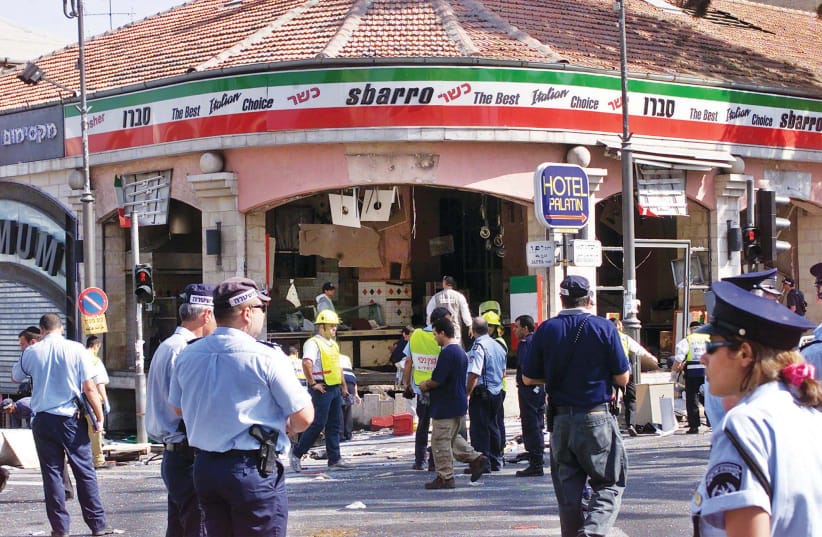
And this makes the father question his memory, too. Could it have been the house next to it? Right? Maybe it was where the American-style pizzeria is. It’s hard to pronounce—the sign has an "s" and a "b" smushed next to each other with no vowel between. The boy and his father eat at the pizzeria. Little Ahmed is fascinated by the stuffed crust.